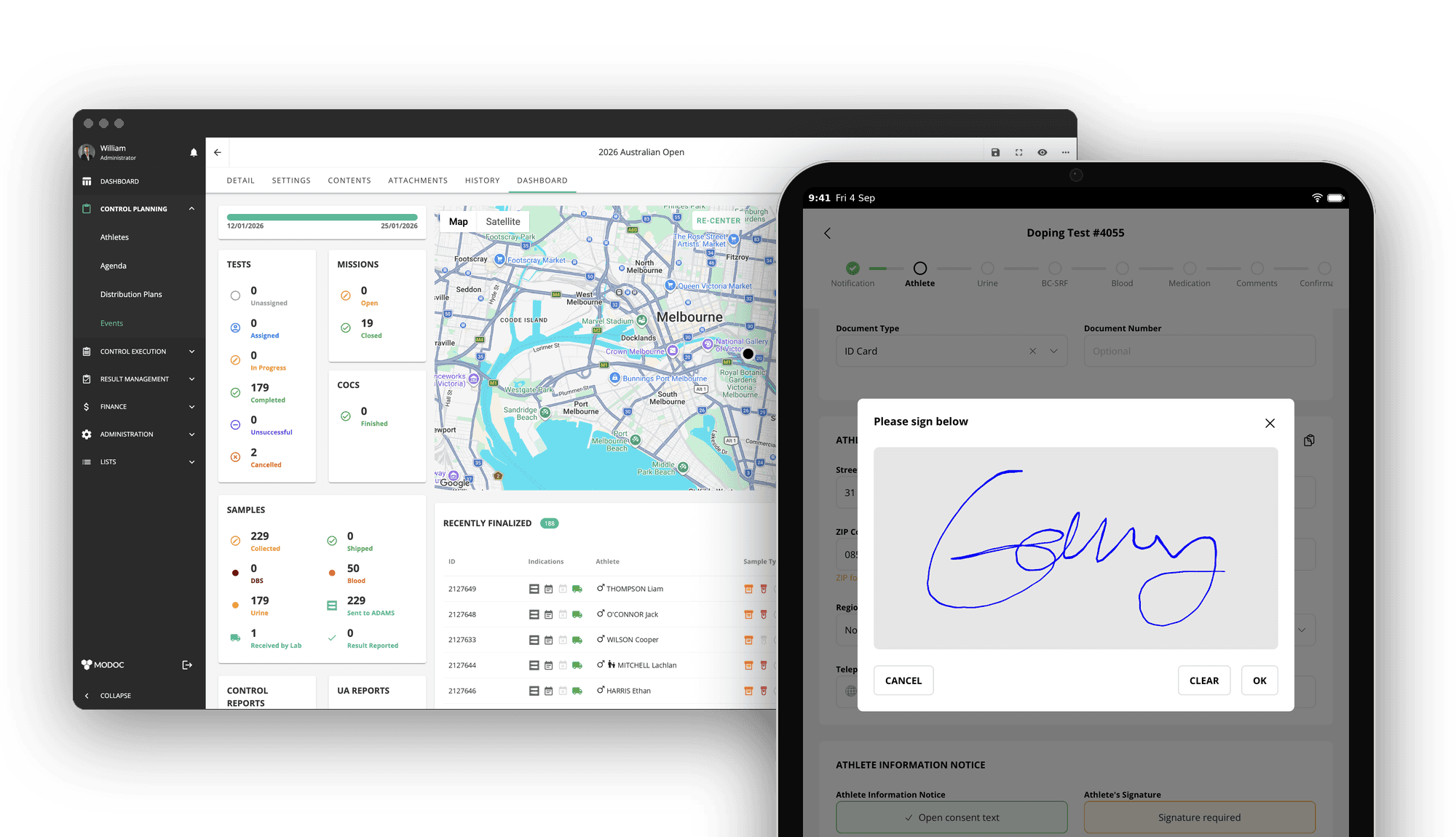
MODOC is the software behind more than 30% of the world’s doping controls: it plans the tests, runs them on tablets in the field, ships the samples to the lab and tracks every sample to its reported result — with no paper anywhere in the chain. It has been in production since 2016, is used on every continent, and processes more than 5,000 tests a month. I started it as a one-month proof of concept, architected it, and built it — with the team I hired and led — into the multi-tenant SaaS it is today.
The starting point
A doping control is field work under legal scrutiny. An officer notifies an athlete, collects a sample, records every step, gets signatures, seals the sample and hands it over to a courier bound for a laboratory. Each of those steps is evidence. For decades the evidence lived on multi-part carbon paper: one missing signature or a wrong code could void a test, and the paperwork travelled at courier speed — days or weeks between a control in a locker room and usable data at headquarters.
MODOC started inside Professional Worldwide Controls (PWC), a German doping-control service provider that runs missions worldwide with a network of well over a hundred officers. PWC did what few operators do: instead of waiting for the market, they built their own mobile app. It worked for PWC — but it was tied to their internal systems, and its first version had reached its limits. PWC saw that other anti-doping organisations shared the same pain and would want the same tool, and that this would take a real product, not an internal one.
That was the brief when I joined CANNYPACK as a solution architect: take the app forward and build the back office it needed — athletes, missions, tests, chain of custody — starting with a proof of concept for WADA’s annual symposium in Lausanne, where most of the world’s anti-doping organisations would be in one room. The symposium was a month away.
One month to Lausanne
It became clear early that the existing codebase would not get us to Lausanne in time, so I wrote the back office myself. The proof of concept was demonstrated on time.
The demo settled two decisions that had been hard to make in the abstract. We rebuilt around a clean core — a new engineering team, a rewritten mobile app, and a proper REST API in place of the old synchronisation. And instead of the boxed product originally envisioned, we chose a multi-tenant SaaS: one platform, every organisation on the current version, improvements shipped to everyone at once. That is how MODOC, the product, was born. It went live in 2016, built by the team I hired, and I have run its delivery ever since.
What we built
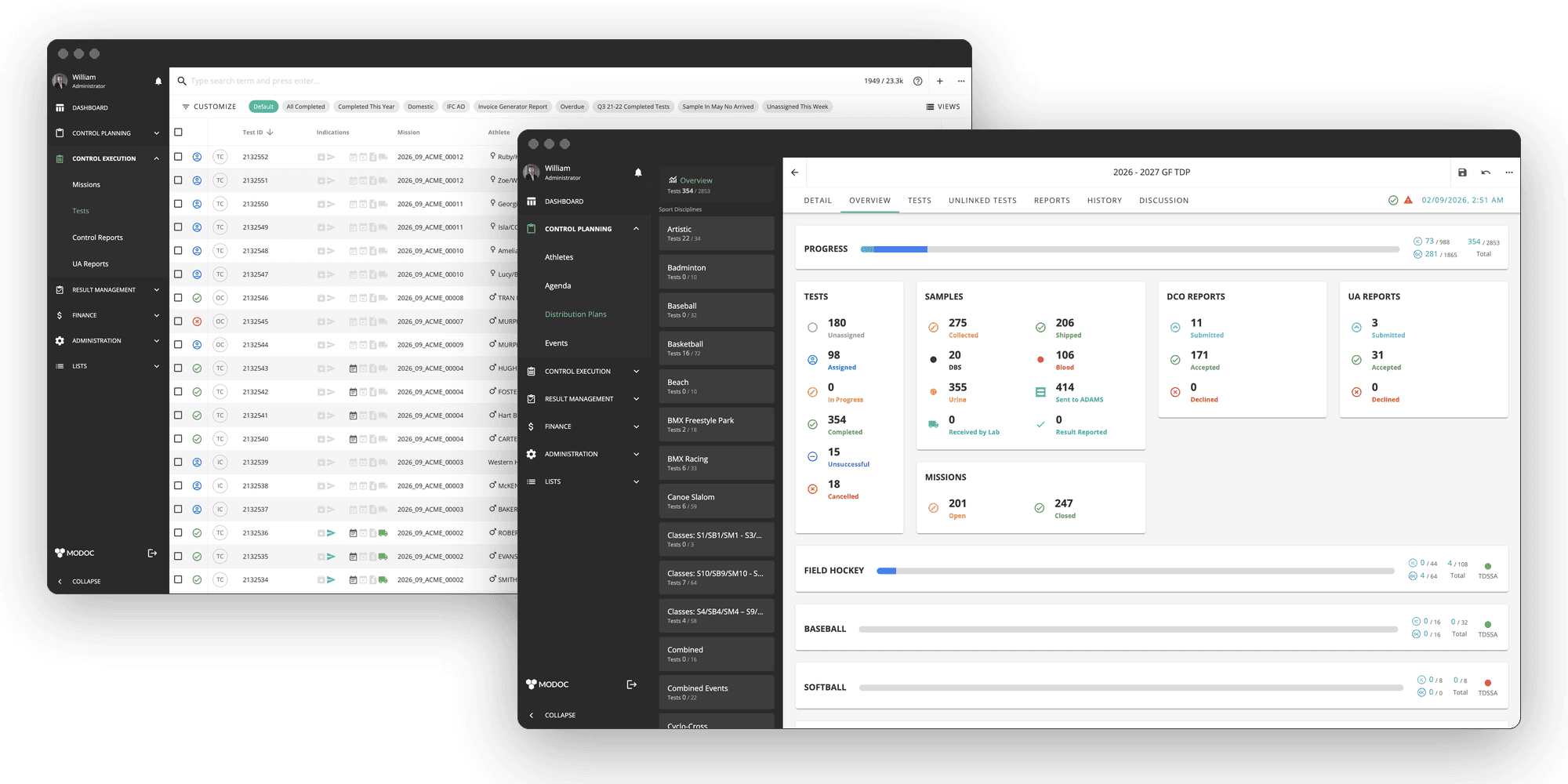
Today MODOC covers the whole lifecycle of a control:
- 01
Planning. Athletes, whereabouts, test distribution plans, missions and events; officers assigned by availability and qualification, workload balanced across a season.
- 02
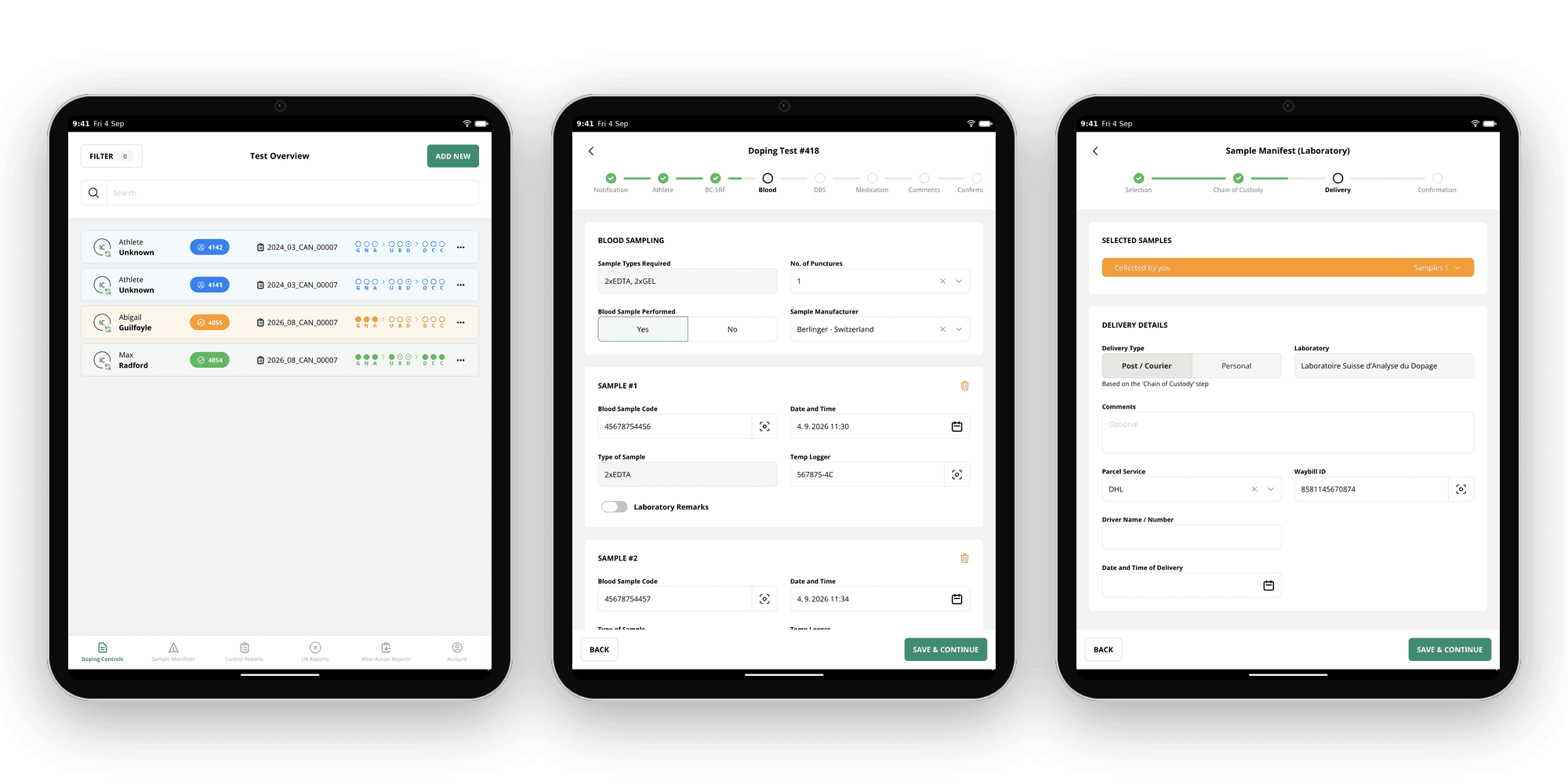
Execution in the field. Officers run every step of a control on a tablet — notification, athlete identification, urine and blood sampling, medication declaration, comments and confirmation — online or offline. Validation happens as the officer works: the system won’t let a session be closed with a required step missing or a sample code that doesn’t match. Athletes read the information notice and sign on the device. Paper forms are generated, when they are still needed, from the recorded data — not the other way round.
- 03
Chain of custody and the lab. Samples are manifested and handed over to a courier or delivered in person, with the laboratory, waybill and custody trail recorded at the moment of handover.
- 04
Results, reporting and finance. Every sample is tracked to the end — received by the lab, result reported — with the status set by the organisation or through the API. Control reports and unsuccessful-attempt reports live in the same records, data is pushed to ADAMS, WADA’s global anti-doping database, and the work is invoiced from the system, with a REST API for anything an organisation wants to connect.
Built for the field, not for the demo
The parts that make MODOC work are not visible in a screenshot. Offline-first, because arenas, training camps and locker rooms rarely have reliable connectivity. Validation that removes categories of error rather than flagging them afterwards. An audit trail on every action, role-based access, two-factor authentication and data masking, because the data is athletes’ medical information under GDPR and the World Anti-Doping Code. And ten years of iterating with the people who actually run controls — officers, coordinators, result managers. It was not designed at a desk and handed down; it was shaped, release by release, by field work.
How it grew
Ten years on one product is not one job. The platform, the way the team works and my own role have all changed along the way.
Launch. MODOC went live as a multi-tenant SaaS: PHP, MySQL and Redis on self-managed servers, with an Angular and Ionic field app written in TypeScript.
CTO. Engineering as a whole, and the product end to end: requirements and solution designs with client organisations around the world, every release across the back office, the API and the mobile apps, the CI/CD pipelines behind them — and the production issues nobody else can crack.
Re-platform. I led the move to TypeScript end to end: a React back office, Node.js services, MySQL, Redis, Elasticsearch and DynamoDB on AWS, and a React Native field app that works offline and syncs over WebSocket.
Agents. The team moved to agentic development without lowering the review bar. I set the standards and the team built the tooling: one rulebook that every coding agent loads, a plan a human approves before any code changes, quality gates before review — and agents that cannot commit. Humans do.
The result
Across national anti-doping programmes, international federations and major events — more than 5,000 tests a month.
Including the Olympic Games in Tokyo 2020 and Beijing 2022, the Paralympic Games in Paris 2024 and Milano Cortina 2026, and World Athletics Championships.
Used by organisations such as USADA, FIFA, the International Testing Agency, Sport Integrity Australia, Anti Doping Denmark and the Dutch Doping Authority.
Session data reaches HQ the moment a control closes — complete, compliant and auditable. Form errors that used to void tests have effectively disappeared.
What carries over
Take the sport out of the story and what carries over is how it was built: requirements agreed with the people who do the work, a design that has survived ten years and a re-platform, every release owned end to end, and the hard production cases handled by someone who knows the code. The domain changes from product to product. That way of working doesn’t.